
The most disorienting thing I tell families isn’t a number. It’s this: Pennsylvania courts don’t calculate what your loved one’s life was worth. They calculate what their death cost. Those are not the same thing, and the gap between those two ideas is where most of the shock lives.
I’ve been doing this work for eighteen years. I’ve sat at kitchen tables in Kensington, Roxborough, and Delaware County explaining why a father who drove a SEPTA bus for twenty-two years might generate a different damages number than a Center City attorney — and why that difference doesn’t mean one life mattered more. People arrive at those conversations carrying ideas from YouTube videos and national settlement websites that were never built for Pennsylvania, never built for Philadelphia, and honestly never built for the reality of what damages litigation actually looks like.
So let me try to do what those sources don’t.
The Myth That Won’t Die: The Formula
Here’s what I see families bring in constantly: the idea that there’s a multiplier. That someone takes your medical bills, multiplies by three or five, and that’s your settlement.
It’s not how wrongful death cases work. In Pennsylvania, it’s especially misleading.
Pennsylvania splits wrongful death recovery into two separate legal tracks:
- The wrongful death action — belongs to surviving family members (spouse, children, parents) as beneficiaries
- The survival action — belongs to the estate of the deceased
These aren’t interchangeable. They compensate different losses, they’re distributed differently, and they’re argued differently before a jury or in settlement negotiations. Conflating them is one of the first ways families get confused — and sometimes one of the first ways they get shortchanged.
The multiplier myth also ignores the single most important variable in any wrongful death case: the specific facts of this person’s life, in this family, in this jurisdiction. There is no chart that covers that.
What the Law Actually Compensates
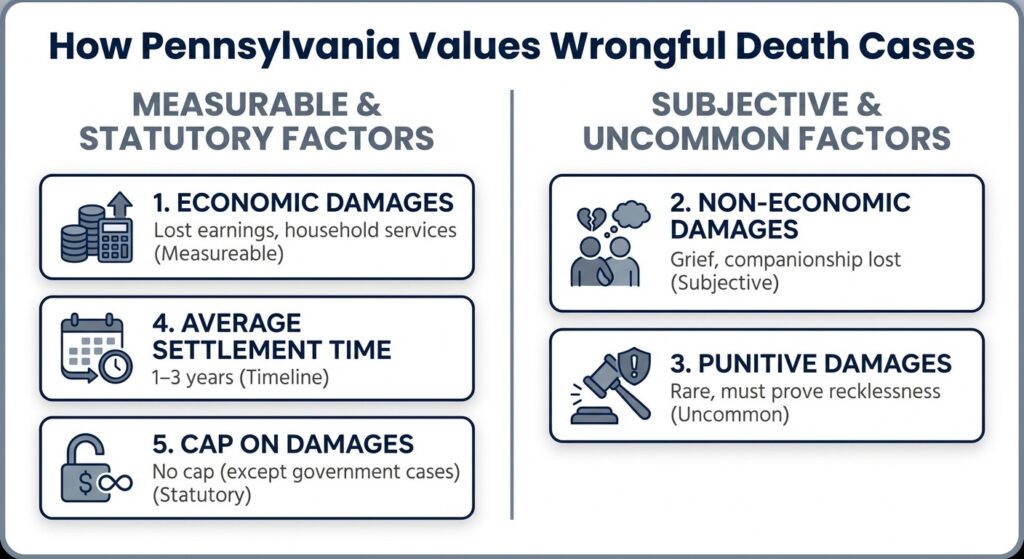
Economic Damages
These are the losses you can, in theory, document and project. Lost earnings and earning capacity are the core — what the deceased would have earned from the date of death through the end of their expected working life. An actuary or vocational economist typically builds this projection using age, occupation, education level, work history, and sometimes union wage schedules or industry data. Human capital valuation methods project income through expected work-life years and can also incorporate non-economic losses like companionship or hedonic value — though Pennsylvania courts treat those categories differently.
This is where the “undervalued” fear comes from, and it’s not unfounded. A 58-year-old union pipefitter with seven years left before retirement generates a shorter earnings projection than a 34-year-old software developer. That’s arithmetic, not a moral judgment.
Economic damages in Pennsylvania also include:
| Category | What It Covers |
|---|---|
| Household services | Cooking, childcare, home maintenance, caregiving |
| Funeral and burial expenses | All reasonable final costs |
| Medical costs | Expenses incurred between injury and death |
| Lost earnings (pre-death) | Survival action: date of injury to date of death |
| Lost earnings (post-death) | Wrongful death action: forward-looking projection |
A competent damages model won’t skip household services. A stay-at-home parent’s contributions have a dollar value, and that value gets calculated.
Non-Economic Damages
This is where the legal system strains hardest against human reality. These are the compensatory damages meant to address what can’t be invoiced: the grief of a surviving spouse, the loss of a parent’s guidance for a minor child, the companionship and consortium that ended the day of the accident. Pennsylvania allows these, and juries in Philadelphia County have historically been willing to award them meaningfully.
But there’s no formula. A jury in Common Pleas Court makes a judgment call, and that call varies.
The survival action matters here too. The estate can recover for the pain and suffering the deceased experienced between the moment of injury and death. If someone died instantly, that window is narrow. If they survived in a hospital for three weeks, it’s not.
Punitive Damages
A realistic word: families sometimes arrive hoping for punitive damages because they’ve read about massive verdicts in other states.
In Pennsylvania, punitive damages require proof of outrageous conduct — recklessness so extreme it goes beyond ordinary negligence. A distracted driver who ran a red light on Broad Street probably doesn’t meet that threshold. A trucking company that knowingly falsified maintenance records and put a dangerous vehicle on I-95 might.
Even when punitive damages are appropriate, Pennsylvania has no statutory cap on them in most civil cases — but courts apply a constitutional proportionality test, and defense attorneys fight them hard. Don’t build your expectations around them unless your attorney has a specific, documented basis.
Why Two Families with Similar Losses Get Different Outcomes
This is the question I hear most often. It deserves a direct answer.
Case value in Pennsylvania wrongful death litigation is shaped by five distinct variables that interact in ways no online calculator can model:
- Strength of liability. How clearly did the defendant’s negligence cause the death? A rear-end collision with a sober driver, a witness, and dashcam footage is a different liability picture than a disputed intersection crash with conflicting accounts.
- Economic profile of the deceased. The actuary builds this out in detail — age, occupation, education, work history, projected trajectory.
- Composition of the surviving family. A spouse and three minor children generate different non-economic damages claims than an adult child with no dependents.
- Insurance coverage available. A defendant with a $100,000 auto policy creates a ceiling that no damages model can break through without additional sources of recovery.
- Jury risk. What a Philadelphia County jury is likely to do with these specific facts, this specific defendant, this specific family.
That last factor matters more than people expect. Experienced litigators in this city track jury verdicts in Common Pleas Court the way other professionals track market data. Philadelphia juries have a reputation for being plaintiff-friendly compared to suburban counties — but that reputation isn’t uniform across case types or defendants. A hospital defendant with a sympathetic narrative and a well-prepared expert gets a different jury reception than a national trucking company with a documented safety record problem.
On insurance companies: Insurers don’t evaluate cases the way a jury does. They run their own damages models, apply their own risk adjustments, and make settlement offers that reflect what they think a jury might do — discounted for the uncertainty of trial. That discount can be significant. Families who accept early settlement offers without understanding the full damages picture sometimes leave substantial recovery on the table.
The Questions Families Actually Ask
Does it matter that my mother didn’t work outside the home?
It matters to the damages calculation, but not the way you might fear. Pennsylvania law recognizes household services as an economic loss. An actuary can calculate the replacement cost of childcare, cooking, transportation, and home management. The number may be lower than a professional salary, but it’s not zero, and it’s not ignored.
What about statutory caps — is there a limit on what we can recover?
Pennsylvania does not cap compensatory damages in most wrongful death cases. There are caps in cases against government entities under the Political Subdivision Tort Claims Act, which limits recovery against municipalities and school districts. Medical malpractice cases have had cap discussions in the legislature for years, but Pennsylvania does not impose a blanket cap on non-economic damages in medical malpractice the way some states do.
If your case involves a government defendant — a PennDOT vehicle, a city-owned facility — the analysis changes significantly. This is a meaningful distinction from national content you may have read, including resources aimed at families working with boston wrongful death attorneys or counsel in other states where the rules differ.
Why does my neighbor’s case seem so different from ours?
Because it is. The liability facts, the insurance coverage, the economic profile, the family structure, and the litigation strategy all diverged from the moment the accidents happened. Comparing settlements between families is like comparing diagnoses — the surface similarity doesn’t mean the underlying cases are the same.
How These Cases Actually Move
Most wrongful death cases in Philadelphia don’t go to trial. They settle — usually after the damages picture is fully developed, meaning after the actuary has produced a report, after depositions have been taken, and after both sides have a realistic sense of what a jury might do. That process typically takes one to three years from filing, sometimes longer in complex cases.
The timeline matters because families are often approached by the defendant’s insurance company early. Sometimes within weeks of the death.
Those early offers almost never reflect the full value of the case. They reflect the insurer’s interest in closing the file before the plaintiff’s attorney has built the damages model. I’ve seen families accept early offers that were a fraction of what a fully developed case would have supported — not because they were foolish, but because they were grieving and exhausted and nobody had explained what they were giving up. Rushing into a settlement before the economic damages are fully built out is one of the most common and costly mistakes I see.
What to Do With This
If you’re reading this after losing someone, the most protective thing you can do right now is slow down before signing anything.
Get a Pennsylvania attorney who handles wrongful death cases specifically — not general personal injury, not out-of-state counsel who references other jurisdictions’ rules. The estate claim and the wrongful death action need to be coordinated from the beginning. Damages models take time to build correctly. The difference between a case that’s fully developed and one that’s settled early, under pressure, can be the difference between financial stability and a number that runs out.
You’re allowed to ask hard questions. You’re allowed to get a second opinion. You’re allowed to take the time this process actually requires, even when the insurance company is pushing for a quick resolution.
The law gives you that right. Use it.